Be yourself; Everyone else is already taken.
— Oscar Wilde.
This is the first post on my new blog. I’m just getting this new blog going, so stay tuned for more. Subscribe below to get notified when I post new updates.
Be yourself; Everyone else is already taken.
— Oscar Wilde.
This is the first post on my new blog. I’m just getting this new blog going, so stay tuned for more. Subscribe below to get notified when I post new updates.
During my school years, we were taught to read and write three languages: Urdu, Persian, and Arabic. Since the alphabets and scripts of the three languages were similar (not the same), it was easy to learn to write them. Poor as we were, we used to practice writing on a wooden plank, which was coated by light-textured clay so that the writing could be washed off, and the clay could be re-applied to almost turn a new page. We used to write with little pens made of bamboo sticks, and the nib was a sharp cut rather than a pointed ball as is the case with a ballpoint or a lead pencil. Scripting words on this wooden plank was an art of angles and edges, and as soon as we gained some mastery over the script, we were encouraged to experiment with the graphic style. Our first act of academic transgression was to learn to write words and sentences into myriad shapes. Writing in designs and patterns was an art form, and it was how the Turks and Persians decorated their buildings. I later learnt that it was called calligraphy (the term from Urdu literally translates into ‘lettering’). Great letterers painted walls and ceilings with words, the intricate designs on quilts and carpets were words, and I have never been to a mosque which is without such ornamentation.
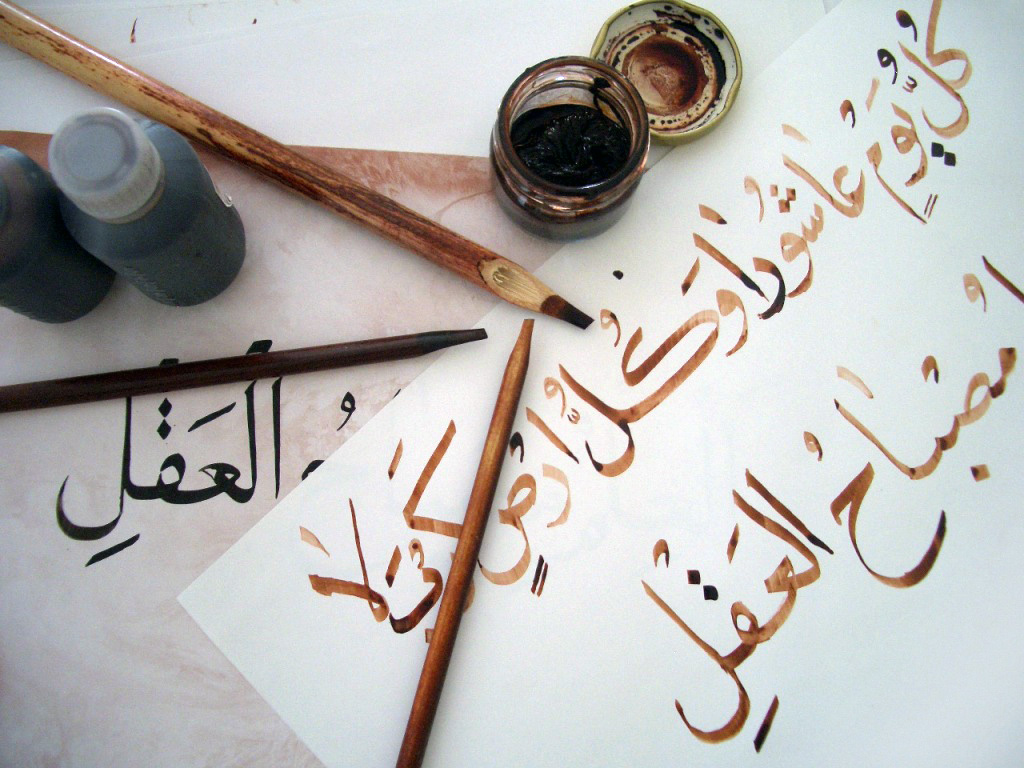


This me-search is a preamble to my search for a topic for the conference paper. I approach this paper with the hypothesis that translingual writing practices and instruction are sites of contested ideologies and liberation from monolingual and monomodal standardization. I started from Bruce Horner and Laura Tetreault’s edited collected titled Crossing Divides: Exploring Translingual Writing Pedagogies and Programs and the January 2016 special issue of College English that was themed “Translingual Work in Composition”. From the latter, Cushman’s article provided the basic groundwork as it highlighted the shortcomings of the existing emancipatory work done in decolonizing the field of composition from imperialist assumptions. Mignolo’s insight that existing interventions, both in theory and practice of decoloniality, only propose a change in the content, and not in the logic of colonization. Cushman’s advocacy of a turn to translingual practices as an emancipatory practice foregrounds strategies like languaging, translating, and dwelling in the borders as new epistemic possibilities. I found Jodi Shipka’s account of transmodality as a site of contesting the monomodal and monolinguistic norm of composition particularly useful. My background in screen studies and new media makes for a natural alliance between writing practices and transmodality. Shipka’s argument is convincing because I experienced it in a primitive form during my childhood. I also explored Bawarshi’s article on genre fixation, and when read in tandem with Shipka, the argument offers further insights into how modality or genre could be the sites of injecting fluidity and agency into the normative and stable composition pedagogies. From Horner and Tetreault’s collection, I have been able to read only one chapter (Chapter 2 from part-1), but it is increasingly clear that translingual practices are steadily becoming the emancipatory tools in the field of composition.
Both collections appeared almost five years ago, and they offer rich bibliographies for further research, my endeavor during the next couple of weeks will be to explore more recent scholarship on the subject. I do think that my tentative hypothesis concerning translingual practice as the site of emancipatory exchanges is an ongoing debate in the field, and I will be able to clarify my own thinking in the next couple of weeks as I read more on the subject.
I don’t know politics but I know the names
Of those in power, and can repeat them like
Days of week, or names of months, beginning with Nehru.
I am Indian, very brown, born in Malabar,
I speak three languages, write in
Two, dream in one.
Don’t write in English, they said, English is
Not your mother-tongue. Why not leave
Me alone, critics, friends, visiting cousins,
Every one of you? Why not let me speak in
Any language I like? The language I speak,
Becomes mine, its distortions, its queernesses
All mine, mine alone.
It is half English, half Indian, funny perhaps, but it is honest,
It is as human as I am human, don’t
You see?
An Introduction by Kamala Das
I grew up reading a lot of poets who wrote in English, but their relationship with English was fraught. Over the top of my head, I can name the Irish great Seamus Heaney and the St. Lucian poet Derrek Walcott. I can perhaps name a dozen or so from the subcontinent who wrote in English, but without a definite sense of the politics of writing in English. Teaching English in a country like Pakistan can be deadly, and I have had my colleagues killed in offices and classrooms for ‘promoting English’. Back home, it is never like teaching any other foreign language, and we learn Urdu, Persian, and Arabic to go with English, but we all know where is the rub. It is the language of the former colonial master, and it is the only one which is considered as a form of cultural invasion. But therein lies the potential as well; the way the postcolonial novel has owned the genre makes for a fascinating historical turn. Any list of the great English novels of the past 60 years will have a fair number of writers from the erstwhile colonies. Most of these novels will be difficult for the English speaking world. In more abstract terms, I want to draw attention to the anxiety implicit in speaking the language of the master, and liberating it from the master.
I loved our readings from this week, and although we were supposed to restrict this response to only one set of readings, I felt that the intersections of race and language as episteme offer plenty to think about. I was buoyed by the force of Wourman & Mavima’s essay and I could see how an emancipatory praxis could be routed through language and its usage. I see the potential of the alliance between emancipatory political movements and the digital media through the examples cited in the essay. My perspective is informed by the fact that I have seen how the digital media have added to the potential of the BLM. From the iconic signs on the tshirts and facemasks to the more indexical changes in the way we approach the idea of a text as the site of political tensions, this week’s readings were just exhilarating. The historical survey presented in both the essays was not just informative, but is a way of informing my practices as a teacher, who incidentally teaches the language of the ‘master’. As Das says in the poem quoted above, the language I speak becomes mine, and I am the one who queers it.
Moe Folk’s essay this week was interesting for me because I tend to assign a lot of video essays to my students. Folk made me think about the possibilities of merging the visuals with the text to explore new possibilities. Folk’s recognition of the fact that “style is distributed throughout modern cultural constructs” underscores the need to re-evaluate the composition processes by exploring the potentiality of the new media for communicative purposes. The radical potential of digital composition lies in the fact that it offers new ways of ‘writing’ or ‘telling’. In the film studies, for instance, where the photographic medium has enjoyed the same privileged status that paper or a blank page on some word processor have enjoyed in the composition classes, the debates about the digital turn sound remarkably like Folk’s analysis. Folk has problematized the digital turn in composition by proposing that technological competence of the users and instructors will remain the most important variable. The problem of style remaining subservient to available technology is a valid, though I take it more as a historical problem than a permanent handicap. In cinema, for instance, photographic composition has only benefited from the digital turn, and the problem of technological competence is steadily being solved by the evolution in the pedagogical practices and syllabus designs. Although I understand that using the templates provided by WIX restricts free expression of anyone’s stylistic choices, I was thrilled by the idea of taking elementary instruction in computer languages from Dr. Josh. Folk is gesturing toward possible disciplinary alliances that can revolutionize the pedagogical possibilities of composition studies.
I also found Star Medzerian Vanguri’s essay on rubrics interesting for the purpose of my own teaching. I chanced upon this essay because I was writing the assignment sheet for one of the courses that I am teaching. I realized, much to my chagrin, that I did not use the word ‘style’ in the rubric, or as Vanguri argues, did not really have a clear idea about what I meant by style. Although I had deliberately avoided mentioning grammatical correctness, I was still prescriptive in giving broader expectations about what an argumentative essay might look like. I could see the validity of the approach taken by the author in asking the instructors to consider the students as their readers and how they understood instructor’s expectations about style.
Loewe’s essay supplemented Folk’s point of approaching writing instruction from novel theoretical perspectives. Although systems theory and cybernetics sound unusual pairings when it comes to writing instruction, the emphasis on understanding the interrelationships between the writer, text, and audience was convincing. The example of the carp to explain how any understanding of a system fails when the parts of the system are studied as enclosed, isolated objects will forever be etched in my memory. By foregrounding the relational nature of the triad, Loewe has proposed a more fluid, and autonomous model of writing and reading in which style is a kind of negotiation that is influenced by both feedback and feedforward loops. It also puts the writer, the text, and the reader in a relational arrangement where each acts and reacts in relation to the other.
Scott Farrin’s essay was not aligned with the other readings but more a reflection of my interest in the issues of voice. As I mentioned in our first class this semester, I cannot overemphasize the value of imitation for an ESL writer. I loved the examples in the essay and see the value of the exercise that we have been assigned in this course where we imitate the style of someone we admire. To go back to T. S. Eliot, knowing the tradition helps foster individual talent as they are not mutually exclusive, but interdependent. I could also read the anxieties about voice and discourse communities in this essay, and its recourse to imitation as an important step in guiding struggling writers was interesting.
The first two chapters of Butler’s Out of Style had provided a historical context to the debates surrounding style and invention. The third chapter situates the debate in the more recent developments in the disciplinary practices. Butler’s claim that style has been an integral part of the process era writing instruction goes against the general perception. A detailed review of the current practices leads Butler to claim that ‘the attempt to dichotomize style and invention reflect an incomplete characterization of the canon’ (62) and that there is a strong tradition of inventional style. The idea that form and content are not mutually exclusive ends of a dichotomy but are ‘organically coexist’ means that style isn’t an addendum to the writing process, or a make over that adds some glitter to the written text sounds logical and natural. So when Lacan theorizes the complex workings of the mind, the form of his writing becomes emblematic of the complexities of his content. Benjamin’s fragmented and episodic writings foreground the fragmentation and disintegration that is characteristic of the late modernity. Beckett’s absurdity is nowhere more apparent than in the form of his sentences and paragraphs, I must concede, however, that my understanding of some of these theoretical perspectives is awfully limited, and Butler’s book offered an immensely rich review of resources that I should read to grow as an instructor.
After providing a historical context, Ray offered insights on contemporary problems that felt important and relevant. The argument steadily shifted away from a normative or prescriptive view of style, and foregrounded plurality of styles and voices. In chapter 4, Ray approaches this idea from the theoretical perspectives of Elbow and Bakhtin. My first introduction to Elbow was in composition pedagogy course, and his views have left profound imprints on my concepts concerning writing. His view of voice matches Bakhtinian view of double voice in treating voice as a varied and evolving concept which is alive and sensitive to the context. Ray argues in favor of texts in which the writer’s presence serves as an inherent style.
Ray’s views on grammar as an active agent of style contribute to the argument, though he is evidently more guarded toward advocating rhetorical grammar. My experience, both as a student and a writing center consultant, has often made me realize the significance of this problem. An overwhelming majority of clients at the writing center have anxieties about grammar. In one of the courses that I took out of English department, I scored a C grade on writing because I erred in the use of articles. I have always felt that prescriptive grammar and correctness are incredibly popular out of the English departments.
This is precisely the reason why I found the debate about the scholars from the field assuming the role of public intellectuals particularly useful. The incredibly popular view that there is a standard English that every student must produce necessitates a greater engagement with public opinion.
Butler’s book offered more of a review of the existing scholarship, and at times overwhelmed me. Butler’s primary argument is lucid and convincing, though the enormous range of her survey makes for a great list of suggested readings. I particularly enjoyed Ray’s book, and my favorites were chapters 6 and 7. As an ESL writer, I found Ray’s argument reassuring because I found his views confirming my practices as a language and composition instructor.
This week’s readings provided a historical survey of the development of the theory of style and helped situate contemporary debates in a broader historical perspective. Style in the pre-classical era, as Ray argues, enjoyed almost universal employment as the idea of a schism between language and thought was not prevalent in this period. This gave the rest of the reading a postlapsarian tone, almost in the way T. S. Eliot writes in nostalgic fashion about the unification of thought and feeling in the Metaphysical poetry. Ray’s suggestion that contemporary composition instructors could learn from this period in the Western history sounds relevant to subsequent debates surrounding the relative position of truth, subjectivity, and agency. Butler’s position foregrounds the tension and the push-pull dynamic of the relative virtues of various aspects of style which is also the primary argument of Ray’s historical survey.
The Sophists and Aristotle represented pole positions, though their seminal nature is acknowledged by both Ray and Butler. I am, however, mindful of the fact that the Greek period privileged verse form over the prose, and these debates did have a context. Plato’s distrust of the poets stemmed from his centering of ‘truth’ and his belief that language could/should offer plain facts sounds a touch naïve today, and I can imagine why the composition scholars of the 90’s offered a more nuanced reading of the Sophists. With the poststructuralist positioning of language as an inherently slippery medium, and the postmodernist distrust of any stable notion of truth, the position of the Sophists seems more aware of the inherent limitations of language. This impression is further supported by Ray’s idea that style offered a range of aesthetic and strategic choices to the Sophists whose end goal was persuasion rather than an accurate description of the truth. Almost uninterrupted reign of the Aristotelian notion of clarity or transparency in the post-Enlightenment history of writing is an evidence of the emergence of science as the most significant discursive force which, in hindsight, seems to have had its seeds in the Renaissance period.
I find Cicero’s focus on context and appropriateness as the lasting virtues of style. Cicero’s three tiers of styles is also interesting because they have remained relevant for much of the history of writing instruction. Quintilian elaborated his notions and made them a part of the curriculum whereas St. Augustine used them in preaching. This suggests that Cicero’s recognition of the context as an important determinant of the degree of stylization of the language can be relevant for a composition instructor who might offer instruction for a wide range of genres today. I also think that Cicero and Quintilian remain central in the field of writing instruction until the elevation of science to the preeminent position during the Enlightenment. Ray’s analysis of the Roman curriculum and the later relevance of Demetrius and Longinus for the teaching of writing is insightful. Although Ray does not provide a detailed analysis of the curriculum in the medieval period, the focus on letter writing foregrounds the utilitarian deployment of style. The Renaissance emphasis on imitation, translation, and analysis is still prevalent in most schools that I am familiar with.
Butler’s summation of contemporary debates about the myth of plain style as a democratic form of writing accessible to all as a problematic position resonated with me. What passes as plain style is often an erasure of subjectivity, and its current position as a norm is, at the very least, troubling. This is where the Black TCP writer’s position statement becomes instrumental in highlighting the privileges that any erasure of difference and subjectivity instantiates. I loved Patricia Bizzell’s idea of ‘discourse community’ when I took pedagogy course with Dr. Lewis, but I have had a troubling relationship with the idea since then.
As a Writing Center consultant and a writing instructor, I find Nora Bacon’s essay incredibly useful and reassuring. Reading Bacon in tandem with Butler, I think that academic writing and style can cohabit productively, and can actually encourage young writers to express themselves with greater freedom. Academic writing is more vital when, as Bacon says, the writer is making choices.
As I read through The Centrality of Style, I was increasingly aware of the argument that style in writing was the contested middle-ground where the personal engages with the social, or to put it in another way, style’s engagement with communicative purpose is dialectical. Through the essays of Rhodes, Carlo, and Greer, there runs the shared concern with tracing the economies of this dialectical relationship between the personal voice and the institutional conventions. In certain ways, this concern is also central to the film studies as well and can be an interesting analogy to understand how style becomes the site of this dialectical relationship.
From 1916 to 1960, the style of Hollywood studio system became a norm not just in the US but also across the globe. As a mode of film practice, this style of filmmaking facilitated audiences’ experience of film viewing by foregrounding strong causal links in the narrative chain of events, emphasizing efficient storytelling by leaving everything superfluous out, and aiding the visual experience by techniques like eyeline match and shot/reverse-shot complemented by a suggestive sound design. David Bordwell pointed to the institutional and canonical standard of this style by calling it Classical Hollywood Cinema. Individual film directors increasingly saw the institutional demands of this kind of cinema as stifling, and steadily resorted to a more personal style which resulted in what we today understand as the auteurist cinema, a mode of film practice which was more reflective of the subjective choices of the ‘auteurs’, as these more ‘independent’ film directors were termed. ‘Auteur’, literally the author, is often seen as the dialectical other of any classical filmmaker, though these are not the mutually exclusive categories, and only refer to the two pole positions. The best visual texts in recent memory have resulted from productive exchanges between these two discursive positions.
Keith Rhodes’ argument that the rebranding or reframing of the style requires a fresh approach to writing, an approach that is sensitive to intercultural, international, and interlingual writing appealed to my own concerns about style and writing. My work as a consultant at the writing center has made my approach to appreciating writing samples of undergraduates more nuanced and sensitive. In this reading response, I have consciously attempted to repeat my focus on the dialectics between the personal voice and the institutional requirements to position my argument in line with Rhodes, Carlo, and Greer to contend that writing pedagogy can only benefit from more inclusive and nuanced approaches to academic writing. These approaches are already evolving because of the technological, and demographic, changes in the practice of ‘writing’.
This is an example post, originally published as part of Blogging University. Enroll in one of our ten programs, and start your blog right.
You’re going to publish a post today. Don’t worry about how your blog looks. Don’t worry if you haven’t given it a name yet, or you’re feeling overwhelmed. Just click the “New Post” button, and tell us why you’re here.
Why do this?
The post can be short or long, a personal intro to your life or a bloggy mission statement, a manifesto for the future or a simple outline of your the types of things you hope to publish.
To help you get started, here are a few questions:
You’re not locked into any of this; one of the wonderful things about blogs is how they constantly evolve as we learn, grow, and interact with one another — but it’s good to know where and why you started, and articulating your goals may just give you a few other post ideas.
Can’t think how to get started? Just write the first thing that pops into your head. Anne Lamott, author of a book on writing we love, says that you need to give yourself permission to write a “crappy first draft”. Anne makes a great point — just start writing, and worry about editing it later.
When you’re ready to publish, give your post three to five tags that describe your blog’s focus — writing, photography, fiction, parenting, food, cars, movies, sports, whatever. These tags will help others who care about your topics find you in the Reader. Make sure one of the tags is “zerotohero,” so other new bloggers can find you, too.
 Salman's Blog