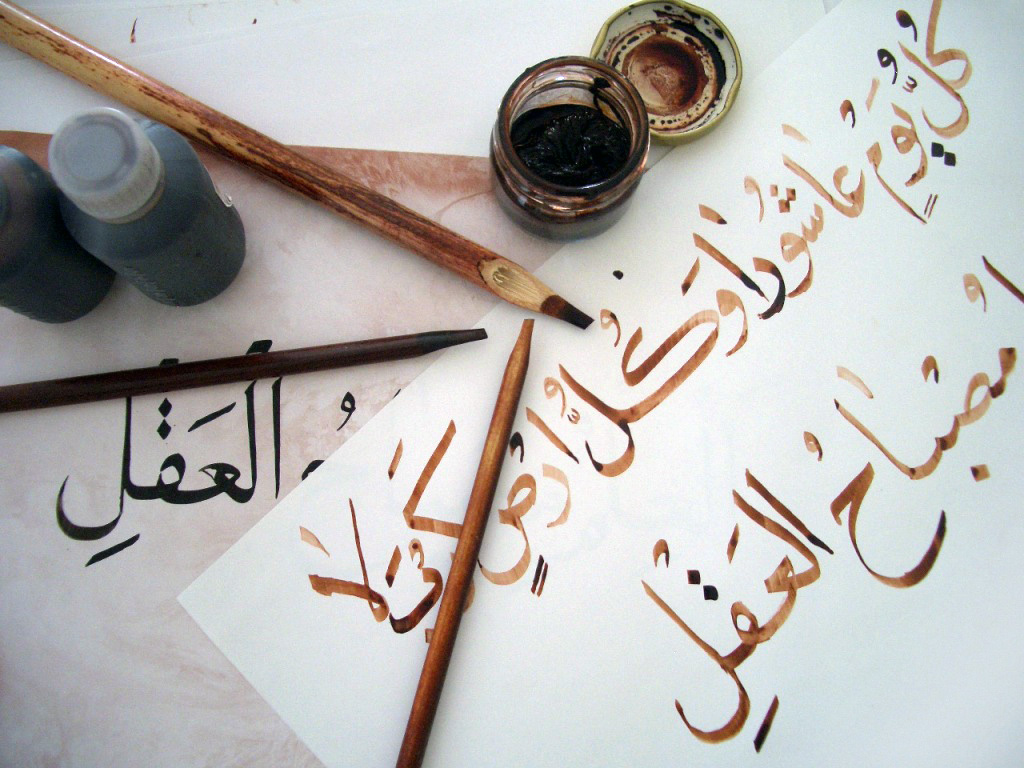
During my school years, we were taught to read and write three languages: Urdu, Persian, and Arabic. Since the alphabets and scripts of the three languages were similar (not the same), it was easy to learn to write them. Poor as we were, we used to practice writing on a wooden plank, which was coated by light-textured clay so that the writing could be washed off, and the clay could be re-applied to almost turn a new page. We used to write with little pens made of bamboo sticks, and the nib was a sharp cut rather than a pointed ball as is the case with a ballpoint or a lead pencil. Scripting words on this wooden plank was an art of angles and edges, and as soon as we gained some mastery over the script, we were encouraged to experiment with the graphic style. Our first act of academic transgression was to learn to write words and sentences into myriad shapes. Writing in designs and patterns was an art form, and it was how the Turks and Persians decorated their buildings. I later learnt that it was called calligraphy (the term from Urdu literally translates into ‘lettering’). Great letterers painted walls and ceilings with words, the intricate designs on quilts and carpets were words, and I have never been to a mosque which is without such ornamentation.


This me-search is a preamble to my search for a topic for the conference paper. I approach this paper with the hypothesis that translingual writing practices and instruction are sites of contested ideologies and liberation from monolingual and monomodal standardization. I started from Bruce Horner and Laura Tetreault’s edited collected titled Crossing Divides: Exploring Translingual Writing Pedagogies and Programs and the January 2016 special issue of College English that was themed “Translingual Work in Composition”. From the latter, Cushman’s article provided the basic groundwork as it highlighted the shortcomings of the existing emancipatory work done in decolonizing the field of composition from imperialist assumptions. Mignolo’s insight that existing interventions, both in theory and practice of decoloniality, only propose a change in the content, and not in the logic of colonization. Cushman’s advocacy of a turn to translingual practices as an emancipatory practice foregrounds strategies like languaging, translating, and dwelling in the borders as new epistemic possibilities. I found Jodi Shipka’s account of transmodality as a site of contesting the monomodal and monolinguistic norm of composition particularly useful. My background in screen studies and new media makes for a natural alliance between writing practices and transmodality. Shipka’s argument is convincing because I experienced it in a primitive form during my childhood. I also explored Bawarshi’s article on genre fixation, and when read in tandem with Shipka, the argument offers further insights into how modality or genre could be the sites of injecting fluidity and agency into the normative and stable composition pedagogies. From Horner and Tetreault’s collection, I have been able to read only one chapter (Chapter 2 from part-1), but it is increasingly clear that translingual practices are steadily becoming the emancipatory tools in the field of composition.
Both collections appeared almost five years ago, and they offer rich bibliographies for further research, my endeavor during the next couple of weeks will be to explore more recent scholarship on the subject. I do think that my tentative hypothesis concerning translingual practice as the site of emancipatory exchanges is an ongoing debate in the field, and I will be able to clarify my own thinking in the next couple of weeks as I read more on the subject.

 Salman's Blog